Should You Buy the Akaso 360 in 2026? A Deep Dive
Introduction — why I wanted a 360 camera
I've been using the Akaso 360 as my daily travel and vlog camera for the last six months, and in that time I've put it through hikes, city walks, a couple of beach days, and several indoor events. I bought it because I wanted an affordable way to capture immersive footage without hauling a big rig — and because I was curious whether sub-$X00 360 cameras in 2026 had finally caught up to the features you actually need.
In this review I’ll share what it was like to live with the Akaso 360 over months of real use: what I loved, what frustrated me, how the image and audio hold up, how the mobile and desktop workflows feel, and whether it’s a smart buy now that newer competitors exist. I won't be linking to retailers or listing affiliate-style recommendations — just my experience, observations, and practical buying advice.
First impressions and build quality
Right out of the box the Akaso 360 felt lighter than I expected. The chassis is mostly plastic but not the cheap, hollow kind — it feels dense and well-molded in the hand. The two lenses are protected by removable caps that fit snugly; I appreciated that because I tend to be clumsy with lens surfaces.
After carrying it in a small shoulder bag for a few weeks I noticed only minor scuffs on the body, but the buttons held up fine. The camera's interface is simple: a small touchscreen, a mode/power button, and a shutter/confirm button. I like the straightforward layout — it’s the kind of UI you can learn in one afternoon and then forget about while shooting.
Image and video performance — the reality vs. expectations
Akaso advertises high-resolution 360 capture, and in my experience the footage is impressive for the price bracket. Daylight footage is crisp with good color — not blockbuster-level dynamic range, but more than acceptable for travel reels and social posts. When I exported stitched 360 files for reframing, details held up well on 16:9 crops and when viewing in a headset.
Low-light is where the camera shows its limits. I tested it during dusk hikes and indoor gatherings: noise becomes noticeable, and shadow detail falls away quickly. I was surprised by how much the internal processing tried to brighten scenes, sometimes producing an overly warm or plasticky skin tone. If you mostly shoot outdoors in good light, you’ll be happy; if you plan to capture concerts or dim interiors, expect compromises.
Stitching generally is clean. I had a few moments where moving objects close to the seam produced the usual ghosting you see on many dual-lens 360 cameras, but those were the exception rather than the rule. I also appreciated the straightening/auto-horizon tools in the app — they made quick edits feel polished without rebuilding files on desktop software.
Stabilization
One of the biggest surprises for me was the stabilization. In handheld walking shots the camera smoothed out bounce nicely. I took it on a trail run (I know, risky for a camera like this) and while I couldn't rely on it as a dedicated action cam for extreme sports, the stabilization made most of my footage usable without a gimbal. When I used it mounted on a chest harness, the results were better than I expected for the price category.
Photo mode and timelapse
Photo quality is solid in daylight; 360 panoramas stitch into clean, shareable images that I used for travel posts. The built-in timelapse and hyperlapse modes are useful — especially when you want a simple workflow without moving files between multiple apps. I did notice that long timelapses can drain the battery significantly, so plan for spare power if you leave it recording for hours.
Audio — pleasantly usable but not perfect
Audio captured on the Akaso 360 is better than most entry-level 360 cameras I've tried, but it's not a replacement for a dedicated external mic. The built-in mics pick up ambient space well and are fine for casual voiceovers and capturing the feel of a place. In windy conditions you’ll need the wind suppression setting and even then some wind noise sneaks through. For vlogs where I wanted an upfront voice track I paired the camera with a lavalier mic recorded separately — that workflow gave me the most consistent results.
Find top-rated Cameras & Photography products at great prices.
See Deals →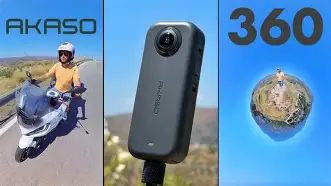
Battery life and memory
I tested battery performance in mixed-use scenarios: walking video, intermittent photo captures, and some timelapses. In my real-world usage I typically get a single battery to last through an hour-ish of continuous recording or a bit longer with short clips and standby. If you plan to shoot long sessions or extended timelapses, carry at least one spare battery. The camera uses microSD cards; I recommend UHS-I V30 or higher for reliable 360 video recording. I learned the hard way that cheaper cards can introduce dropped frames during long recordings.
App and editing workflow
The mobile app is central to the Akaso 360 experience. I used it to preview shots, stitch footage, and do quick reframing edits before posting. The good news: the app is easy to navigate and fast for basic tasks. The bad news: the app's export times can be long when rendering full-resolution 360 footage on older phones, and some advanced adjustments required me to move to desktop software.
On desktop, the workflow is straightforward if you already use a 360-aware editor. The desktop stitching and color-correction tools give you more control and cleaner final exports. If you're someone who only edits on mobile, know that you will trade some quality for speed — but it's a practical compromise for social-first creators.
Accessories and ecosystem
Akaso bundles are generous for the price: a couple of mounts, a short handheld stick, and spares. That said, the accessory ecosystem isn't as deep as Insta360's or GoPro's. I found good third-party mounts that fit the camera, but if you rely on manufacturer-made accessories or want a seamless ecosystem of mods and attachments, you'll find fewer options.
Durability and waterproofing
The body held up to daily tosses into a camera bag and the occasional drop better than I expected, but it's not indestructible. The camera is splash-resistant and will survive light rain, but I treated it as not fully waterproof unless protected by a case. For beach days I used a dedicated waterproof housing — if you plan to shoot in wet environments often, budget for protective cases.
Pros & Cons
- Pros: Very good day-time image quality for the price; clean stitching in most situations; surprisingly effective stabilization for handheld and chest-mounted shots; simple, approachable UI; useful mobile app for quick edits.
- Cons: Low-light performance is weak compared to higher-end models; app export times can be long; accessory ecosystem is limited; battery life requires carrying spares for long sessions; wind handling in audio is only passable.
Comparison — Akaso 360 vs common alternatives
To help put the Akaso 360 into context, here’s a compact comparison table I used when considering whether to keep it or upgrade. I evaluated how these cameras fit into typical workflows rather than listing every spec.
| Model | Typical Video Quality | Stabilization | App / Editing | Battery & Usability | Best for |
|---|---|---|---|---|---|
| Akaso 360 | High for budget 360; excellent in daylight, weak in low light | Good; smooths walking shots well | Simple mobile app; decent desktop options | Average battery; needs spare for long shoots | Travelers and casual creators on a budget |
| Insta360 X3 (or similar) | Very good; stronger low-light handling and detail | Excellent; industry-leading stabilization | Feature-rich app and desktop suite | Better battery options and ecosystem | Serious creators who want pro-like results |
| GoPro Max / Fusion-era | Good; solid colors and robust processing | Good to excellent depending on firmware | Good editing support; fewer 360-specific features now | Rugged; solid accessory support | Action-oriented users who also want 360 |
My real-world use cases and results
Here are concrete ways I used the camera and the results I got:
- Day hikes and scenic shots: These are where the Akaso shined. Crisp footage, pleasing colors, and easy reframing made quick travel edits that looked polished. I shared several 360 panoramas that got strong engagement on social channels.
- City walking vlogs: The stabilization smoothed most motion and I liked being able to capture an entire environment without panning. When I exported standard 16:9 crops, viewers couldn't tell it was shot on a more affordable 360 camera unless they looked closely at fine details.
- Indoor events and low light: This is the camera’s weakest area. Footage looked noisy and highlights were clipped more often than I would like. For evening indoor events I reached for a different camera or supplemented with external lighting.
- Quick social posts: The mobile app made it easy to stitch and export short clips straight from my phone. It’s great when you need a fast turnaround.
Buying guide — what to consider before you buy
If you're thinking of buying the Akaso 360 in 2026, here are the practical questions I asked myself — and the answers I’d give based on months of use.
1. What will you primarily shoot?
If most of your footage is outdoor, daylight scenes — travel, hikes, cityscapes — the Akaso 360 gives excellent value and will serve you well. If you shoot a lot of low-light events, concerts, or night vlogs, consider spending more for a camera with stronger sensors or a better low-light pipeline.
Shop the latest Cameras & Photography picks on Amazon.
View Offers →2. Do you need advanced editing features or fast mobile exports?
The Akaso app is fast for quick edits, but heavy users who want the most control will prefer desktop editing. If your workflow is strictly mobile-first and you demand the highest possible final quality from your phone, compare export speeds and quality on your exact phone model before committing.
3. Battery and portability
Plan on at least one spare battery if you’re shooting all day. If you’re traveling light, factor in how many batteries you can realistically carry and whether you’re comfortable swapping them mid-day. I ended up buying a small power bank and a compact charger to keep things running.
4. Accessory needs
Think about the mounts and housings you need. If you want a deep ecosystem of manufacturer accessories, a different brand might be better. But if you want basic mounts and a few third-party options, the Akaso fits fine.
5. Future-proofing
In 2026, camera features evolve rapidly. Consider whether firmware updates and ongoing app support matter to you. Akaso has delivered useful firmware tweaks in my experience, but it's not as consistent as larger brands. If long-term manufacturer support is a high priority, weigh that in your decision.
Price vs. value — is it worth it in 2026?
Value is subjective, but from my standpoint after months of use the Akaso 360 offers compelling value for creators who prioritize affordability and convenience over best-in-class low-light performance and a deep accessory ecosystem. For quick travel captures, social-first content, and experiments with 360 storytelling, it was a joy to use most days.
What I found was that I used the camera more than I expected because it removed friction: lightweight, easy to carry, and quick to edit. That accessibility translated into more content captured, which to me is a large part of the value equation.
Final thoughts and conclusion
Should you buy the Akaso 360 in 2026? In my experience, yes — if your priorities are affordability, simple workflows, and great daylight 360 footage. I appreciated the solid stabilization, clean daylight images, and the fact that I could stitch and post from my phone when I needed to. The things that bothered me most were the low-light performance and the relatively short battery endurance for extended shooting days. If those are deal-breakers for you, consider stepping up to a more premium 360 model.
Personally, I kept the Akaso 360 in my kit because it made capturing immersive moments easy and fun. It won’t replace a full mirrorless kit for planned, high-stakes shoots, but for day-to-day immersive storytelling it hit the sweet spot between capability and cost. If you’re curious about 360 content and want a camera you can carry every day without worrying about huge investment, the Akaso 360 is worth strong consideration.